
Type 1 engine torque specs for the VW Beetle and Bus T1/T2 – table with cylinder head tightening sequence
In short: Here you will find all the important tightening torques for the Type 1 engine of the VW Beetle, Karmann Ghia and Bus T1/T2 at a glance – from the cylinder heads (M8 25 Nm / 18 ft-lb, M10 30 Nm / 22 ft-lb) and the connecting rod nuts (35 Nm / 26 ft-lb) to the flywheel gland nut (350 Nm / 258 ft-lb). Plus the tightening sequence for the cylinder head nuts and the key rules, so nothing leaks or strips.
At a glance
- Applies to: air-cooled Type 1 engines 1200–1600 cc in VW Beetle, Karmann Ghia, Thing (Type 181) and VW Bus T1/T2
- Units: 1 mkp (or mkg) in old manuals is roughly 10 Nm; 1 Nm = 0.74 ft-lb
- Basic rule: threads clean and lightly oiled, tighten in several stages and in a cross pattern
- Tip: print this page and hang it up in your workshop
What you need
- A torque wrench for approx. 5–60 Nm (4–45 ft-lb) and – for the flywheel – a large wrench up to 350 Nm (258 ft-lb) or a torque tool for flywheel and axle nut
- For the flywheel gland nut: 36 mm socket with 3/4" drive and a flywheel lock for the Type 1 engine
- For an engine build: Elring engine gasket set for the Type 1 engine and new nuts, e.g. the complete engine hardware kit
- Engine oil to wet the threads, sealant for the nuts inside the rocker chamber
Why the right torque matters
The Type 1 engine case is made of a magnesium alloy and the cylinder heads of aluminium. Both are much softer than steel. If you tighten a nut too much, the stud pulls out of the case or the cylinder head distorts. If it is too loose, the cylinder heads, case halves or oil pump leak – and a loose flywheel gland nut can, in the worst case, damage the crankshaft. With a torque wrench you are on the safe side.
Type 1 engine tightening torques
| Bolt / nut | Torque |
|---|---|
| Cylinder heads and valve train | |
| Cylinder head nuts – snug down | 10 Nm / 7 ft-lb (sequence: see diagram below) |
| Cylinder head nuts on M8 studs | 25 Nm / 18 ft-lb |
| Cylinder head nuts on M10 studs | 30 Nm / 22 ft-lb |
| Rocker shaft (M8, copper-plated nuts) | 25 Nm / 18 ft-lb |
| Spark plugs | 30 Nm / 22 ft-lb |
| Crankshaft assembly and engine case | |
| Connecting rod nuts | 35 Nm / 26 ft-lb |
| Case nuts M12 / M10 (main bearings) | 35 Nm / 26 ft-lb |
| Case nuts M8 | 20 Nm / 15 ft-lb |
| Flywheel and clutch | |
| Flywheel gland nut (36 mm) | 350 Nm / 258 ft-lb (older figure for Beetles up to model year 1974: 300 Nm / 217 ft-lb) |
| Clutch pressure plate to flywheel | 25 Nm / 18 ft-lb |
| Engine to gearbox | 30 Nm / 22 ft-lb |
| Oil system | |
| Oil pump (cover nuts) | 20 Nm / 15 ft-lb |
| Oil strainer cover – M6 cap nuts | 7–8 Nm / 5–6 ft-lb |
| Oil strainer cover – M8 sealing nut in the centre (if fitted) | 25 Nm / 18 ft-lb, sealing ring facing inwards |
| Oil drain plug (if fitted) | 25 Nm / 18 ft-lb |
| Pulleys and cooling fan | |
| Generator pulley (21 mm nut) | 60 Nm / 44 ft-lb |
| Fan special nut | 60 Nm / 44 ft-lb |
| Crankshaft pulley | 45 Nm / 33 ft-lb (do not exceed on aluminium pulleys) |
Cylinder head nut tightening sequence
Tighten the cylinder head nuts in two passes with different sequences. This way the cylinder head sits evenly on the cylinders and seals properly.
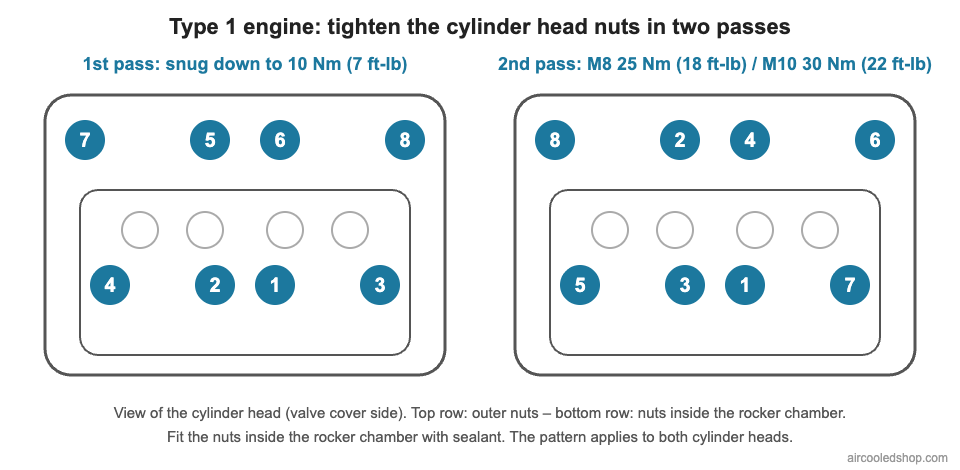
- Prepare. Clean the stud and nut threads and wet them lightly with engine oil. Fit the nuts inside the rocker chamber with sealant so no oil creeps out along the stud.
- 1st pass – snug down. Tighten all eight nuts lightly to 10 Nm (7 ft-lb) in the order of the left diagram.
- 2nd pass – final torque. Tighten all nuts to final torque in the order of the right diagram: M8 studs 25 Nm (18 ft-lb), M10 studs 30 Nm (22 ft-lb).
- Tighten the second cylinder head the same way. Then fit the rocker shaft at 25 Nm (18 ft-lb) and adjust the valve clearance.
M8 or M10? Depending on the engine and case, M8 or M10 studs are fitted – after repairs sometimes mixed. Measure the stud diameter before tightening and use the matching value.
Key rules for tightening
- Clean and lightly oiled: Dirt or dry threads falsify the torque – the nut ends up looser than the wrench shows.
- In stages and in a cross pattern: Never pull case nuts, oil pump or clutch pressure plate to final torque one by one – work round in two or three stages.
- Replace self-locking nuts: Nuts with a locking insert lose their locking effect once removed.
- Watch out with extensions: An adapter that lengthens the lever arm of the torque wrench changes the actual torque. Socket extensions in line with the axis are not a problem.
- Reset the torque wrench: After use, set click-type wrenches to the lowest value so the spring does not fatigue.
Tips from the workshop
- Workshop tip for modified engines: On performance Type 1 engines, tightening the six large main bearing nuts (M12) to 45 Nm (33 ft-lb) instead of 35 Nm has proven itself in practice – the case lasts longer. This is experience from engine building, not a VW specification. For stock engines, use the 35 Nm (26 ft-lb) in the table.
- Flywheel only with a lock: You can only reach 350 Nm (258 ft-lb) if the crankshaft is locked securely. A flywheel lock stops the engine turning on the stand.
- Pulled stud? Do not try to "save" it with more torque. Thread inserts or new studs will help – ask us if in doubt.
- Spark plugs with feel: The plugs sit in an aluminium cylinder head. Screw them in by hand until they seat, then tighten to 30 Nm (22 ft-lb) – matching Bosch W8AC spark plugs are available from us in a pack of four.
Common mistakes
- Cylinder head tightened without the sequence: The head seats unevenly, the cylinders leak and lose compression.
- "By feel" on the magnesium case: Stripped threads in the case are an expensive repair.
- Drain plug and strainer cover too tight: The soft case thread gives way – replace the sealing ring rather than tightening harder.
- Rocker chamber nuts without sealant: Oil creeps out along the stud.
Frequently asked questions
What is the cylinder head torque on a Beetle?
First snug down all nuts to 10 Nm (7 ft-lb) in the specified order, then tighten to final torque in the second order: 25 Nm (18 ft-lb) on M8 studs, 30 Nm (22 ft-lb) on M10 studs.
How tight is the flywheel gland nut on a Type 1 engine?
350 Nm (258 ft-lb). For Beetles up to model year 1974, older manuals give 300 Nm (217 ft-lb). The crankshaft must be locked with a flywheel lock.
How do I convert mkp to Nm?
1 mkp (metre-kilopond) or 1 mkg equals 9.81 Nm – in practice simply multiply by 10. So 3.5 mkp is roughly 35 Nm (26 ft-lb).
Matching parts and more guides
- VW Beetle engine parts, Type 1 engine case and studs, VW Bus T1 engine parts and VW Bus T2 engine
- Tools for the air-cooled VW
- More guides: Valve adjustment, Oil change and Fan belt tension – all guides are in our Guides & Tips overview.
All work is carried out at your own risk. The values apply to stock engines; for performance parts, follow the manufacturer's specifications. If you are unsure, a specialist workshop will help you.