
Adjusting the carburetor on the VW Beetle and Bus: idle speed, CO and mixture on the Solex PICT
In short: Adjust the Solex carburetor on your VW Beetle or Bus with the engine warm: idle speed 800–900 rpm (automatic 850–1000 rpm), then the mixture with the small volume screw – ideally with a CO tester, otherwise by engine speed. On the 30/31/34 PICT-3 and -4 you set the idle speed with the large air bypass screw, on the older 28/30 PICT-1 and -2 with the throttle stop screw. Ignition and valve clearance must be correct first.
Fact sheet
- Difficulty: medium
- Time needed: approx. 30–45 minutes (plus warm-up drive)
- Fits: VW Beetle, Karmann Ghia, Thing (181), VW Bus T1 and T2 1600 with Type 1 engine and single Solex carburetor 28–34 PICT
- Important: set ignition and valves first, then the carburetor
What you need
- Tachometer (workshop tester with rpm and dwell display)
- Narrow flat screwdriver for the volume and bypass screws
- CO tester (recommended for exact mixture setting)
- If needed: carburetor gasket, tune-up kit or rebuild kit
Why correct adjustment matters
A badly adjusted carburetor shows up quickly: rough idle, stalling at traffic lights, stumbling when you accelerate, popping back through the carburetor or high fuel consumption. A lean mixture also makes the air-cooled engine run hotter – hard on valves and pistons. With the right idle speed and mixture your Beetle or Bus runs smoothly and economically again.
Check first: ignition, valves, air leaks
The carburetor is always the last step. Only adjust it when these points are right:
- Valve clearance set – see Valve adjustment
- Point gap, ignition timing and spark plugs OK – see Ignition timing
- No air leaks: carburetor tight on the intake manifold, gasket intact, rubber boots on the manifold sealed
- Air filter clean and fitted, all vacuum hoses connected
- Engine warm (oil temperature approx. 60 °C / 140 °F), the choke valve must be fully open
Which carburetor does your VW have?
The type designation is marked on the carburetor. The adjustment differs by version – so check first:
| Vehicle / engine | Year | Carburetor |
|---|---|---|
| Beetle 1200 (34 hp) | up to 1967 1968–1970 from 1971 |
28 PICT-1 28 PICT-2 30 PICT-3 (from 8/1975 matched to the dry air filter) |
| Beetle / Karmann 1300 | up to 1967 1968–1970 from 1971 (44 hp) from 8/1973 (engine code AR) |
30 PICT-1 30 PICT-2 31 PICT-3 31 PICT-4 |
| Beetle / Karmann 1500 (44 hp) | up to 1967 from 1968 |
30 PICT-1 30 PICT-2 |
| Beetle 1302 / 1303, Karmann 1600 (50 hp) | from 1971 (AD, AS) from 8/1975 (AS) |
34 PICT-3 34 PICT-4 |
| Bus T1 1200 / 1500 | up to 7/1967 | older Solex (e.g. 28 PICT, 28 PICT-1, 30 PICT-1) – adjust like PICT-1/-2 |
| Bus T2 1600 (Type 1 engine) | 1968–1970 from 1971 |
30 PICT-2 34 PICT-3 |
| Bus T2 1.7–2.0 l (Type 4 engine) | from 1971 | twin carburetors 34 PDSIT or fuel injection – not covered by this guide |
Not sure which engine is fitted? Our guide Identify your engine helps you.
Which screw does what?
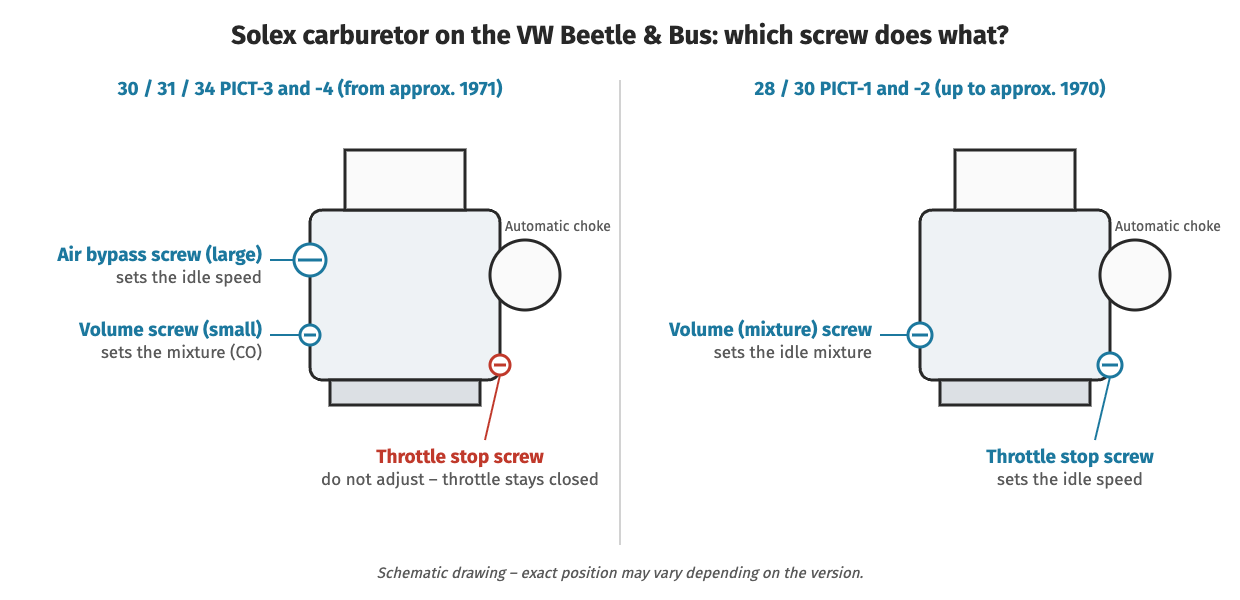
- 30/31/34 PICT-3 and -4: The throttle valve stays fully closed at idle. You set the idle speed with the large air bypass screw and the mixture with the small volume screw (CO screw). The throttle stop screw is set at the factory and is not adjusted.
- 28/30 PICT-1 and -2: There is only one volume (mixture) screw. You set the idle speed with the throttle stop screw on the throttle lever.
The right values
| Value | Spec |
|---|---|
| Idle speed, manual gearbox | 800–900 rpm |
| Idle speed, automatic / semi-automatic | 850–1000 rpm |
| Engine temperature when adjusting | warm, oil temperature approx. 60 °C (140 °F), choke valve fully open |
| Basic setting volume screw (PICT-3/-4) | screw in gently until it seats, then back out 2½ turns (practical starting value) |
| Accelerator cable | with the pedal fully pressed 1–1.5 mm (0.04–0.06 in) clearance between throttle lever and stop |
| Ignition first | point gap 0.4 mm (0.016 in), timing according to engine – see Ignition timing |
CO value by year
| Vehicle | CO at idle |
|---|---|
| Beetle 1200 / 1300 / 1600 up to 7/1975 | 2–4 vol. % |
| Beetle from 8/1975 | 1.0–3.0 vol. % |
| Bus T2 1600 up to model year 1975 | 3 ± 1 vol. % |
| Bus T2 1600 from model year 1976 | 2 ± 1 vol. % |
| older PICT-1/-2 carburetors (up to 1970) | no CO spec – adjust by engine speed (see below) |
Step by step: adjusting the 30/31/34 PICT-3 and -4
- Basic setting (only after repairs or if completely out of adjustment): screw the volume screw in gently until it seats – do not force it or the tip gets damaged – and back it out 2½ turns.
- Warm up the engine and connect the tachometer. Check that the choke valve is fully open and the idle screw no longer rests on the stepped cam of the automatic choke.
- Rough idle speed: use the large air bypass screw to set approx. 900 rpm.
- Set the mixture: slowly back out the small volume screw until the engine speed is highest. Then slowly screw it in again until the speed drops by approx. 25 rpm.
- Readjust idle speed: with the air bypass screw to 800–900 rpm (automatic 850–1000 rpm).
- With a CO tester: measure CO and bring it to the value in the table with the volume screw. Then correct the idle speed once more with the air bypass screw.
- Test: blip the throttle and let go – the engine must drop cleanly back to idle and must not stall.
Step by step: adjusting the 28/30 PICT-1 and -2
- Warm up the engine, choke valve fully open, the idle screw must not rest on the stepped cam.
- Set the mixture: turn the volume screw clockwise (in) until the speed drops and the engine almost stalls. Then turn it back out ¼ turn counterclockwise until the engine runs smoothly again.
- Set the idle speed: with the throttle stop screw to 800–900 rpm.
- Test: press the clutch, open the throttle quickly and close it again. If the engine stalls, the mixture is too lean – back out the volume screw by about 1/6 turn and test again.
Caution: Only run the engine outdoors or with exhaust extraction – exhaust gas contains poisonous carbon monoxide. Keep hands, hair and tools away from the fan belt.
Adjusting and checking the automatic choke
- Setting: turn the cover with bimetal spring and heater coil so that the notch lines up with the middle mark on the housing. When fitting the cover, the spring loop must engage the choke valve lever.
- Cold check: with the engine cold, press the accelerator once – the choke valve closes and the idle screw sits on the top step of the stepped cam.
- Heater check: switch on the ignition or start the engine. The cover must get warm after a short time and the choke valve opens slowly. If the cover stays cold, check the wire and the automatic choke heater element.
- Warm check: with the engine warm the choke valve is fully open and the idle screw no longer rests on the stepped cam.
Check at the same time: the idle cut-off valve must click audibly when you switch on the ignition. If it does not click or has no power, the engine stalls at idle.
Checking the accelerator pump
A flat spot when you accelerate often points to the accelerator pump. Check it like this:
- Run the engine briefly so the float chamber is full, then remove the air filter.
- Hold the choke valve open by hand and operate the throttle: a strong, even jet must come from the injection tube immediately.
- Exact measurement: hold a measuring cylinder under the injection tube, open the throttle fully and briskly 5 times and divide the quantity by 5. Compare with the spec:
| Carburetor | Injection quantity per stroke |
|---|---|
| 30 PICT-3 (1200) | 1.05–1.35 cm³ |
| 31 PICT-4 (1300, from 8/1973) | above +20 °C (68 °F): 1.15–1.45 cm³ · below +15 °C (59 °F): 1.8–2.2 cm³ |
| 34 PICT-3 (1600) manual gearbox | 1.3–1.6 cm³ |
| 34 PICT-3 (1600) automatic | 1.15–1.45 cm³ |
| 34 PICT-4 (1600, from 8/1975) | above +29 °C (84 °F): 0.75–1.05 cm³ · below +21 °C (70 °F): 1.25–1.55 cm³ |
If too little or nothing comes out, the pump diaphragm is usually hard or torn. The diaphragm is included in every carburetor rebuild kit.
Adjusting the accelerator cable
- A second person presses the accelerator pedal all the way down.
- There must be 1–1.5 mm (0.04–0.06 in) clearance between the throttle lever and its stop on the carburetor body.
- Tighten the cable in the clamp screw on the throttle lever in this position and check again. This keeps the carburetor from being overstressed at full throttle and the cable from breaking.
Mechanic's tips
- Count the turns: before you move a screw, count the turns until it seats and write them down. That way you can always return to the starting point.
- Small steps: only turn the volume screw by an eighth to a quarter turn and give the engine a few seconds.
- Clean the idle jet: if the idle cannot be adjusted, the idle jet is often blocked. Remove it and blow it out with compressed air – never poke it with wire.
- 34 PICT-4 with manual gearbox: set the throttle damper so that there is a 1 mm (0.04 in) gap between the lever and the fully pressed-in plunger.
- New carburetor: a new 34 PICT-3 or 30/31 PICT-3 comes preset, but must always be adjusted for idle and CO on the engine.
Common mistakes
- Adjusted cold: with a cold engine the automatic choke is still working – none of the values will be right afterwards.
- Idle set on the throttle stop screw (PICT-3/-4): the throttle valve must be closed at idle. The speed belongs on the air bypass screw.
- Air leaks overlooked: a leaking carburetor gasket or cracked manifold boots ruin any adjustment.
- Ignition not checked first: wrong timing changes the idle speed – ignition first, then carburetor.
- Volume screw forced in: the tip deforms and the idle can no longer be set cleanly.
FAQ
What idle speed does the VW Beetle have?
800–900 rpm with manual gearbox, 850–1000 rpm with automatic or semi-automatic – always with the engine warm.
What is the difference between the air bypass screw and the volume screw?
On the 30/31/34 PICT-3 and -4 the large air bypass screw sets the idle speed, the small volume screw sets the air/fuel ratio (CO value).
Can I adjust the carburetor without a CO tester?
Yes. The engine speed method (find the highest speed, then turn back slightly) gives a good result. For the exact CO value you need an exhaust gas analyzer – for example at the next emissions test.
My Beetle stalls when I lift off the throttle – why?
Usually the mixture is too lean or the idle speed too low. Also check the idle cut-off valve: it must click when you switch on the ignition.
Which carburetor does the Beetle 1600 have?
The 50 hp engine in the Beetle 1302/1303 and Karmann Ghia has the Solex 34 PICT-3 from 1971 and the 34 PICT-4 from 8/1975. The 34 PICT-3 in our shop replaces both.
Matching parts and more guides
- Carburetors: 34 PICT-3 carburetor (1600), 30/31 PICT-3 carburetor with adapter, 30 PICT carburetor
- Repair: rebuild kit 34 PICT, rebuild kit 31 PICT-4, rebuild kit 28/30 PICT, tune-up kit Solex 28–34 PICT, idle jet, injection tube
- Carburetor electrics: idle cut-off valve 30/34 PICT-3 and -4, cut-off valve 28/30 PICT-1/-2, automatic choke heater element 12 V
- Gaskets and cable: carburetor gasket 34 mm, carburetor gasket 28–31 mm, accelerator cable Beetle, accelerator cable Bus T2
- Categories: Carburetors & fuel pumps VW Beetle, Carburetors VW Bus T2
- More guides: Ignition timing, Valve adjustment, Installing the distributor, Identify your engine, VW Bus T2 technical data – all guides in our Guides & Tips overview.
All information without guarantee. All work is carried out at your own risk. If you are unsure, ask a specialist workshop.