
Rust on the VW Beetle: how to spot the typical rust areas, prevent rust and fix it with the right repair panels
In short: The VW Beetle almost always rusts in the same places: the heater channels (sills), the floor pans – especially under the battery –, the frame head, the rear quarter ends, the spare wheel well and the bottoms of the doors. With a torch, a screwdriver and a magnet you can find the weak spots in an hour. Prevention means: get the water out and protect the cavities. Load-bearing parts such as the frame head and heater channels should be repaired by a professional body shop.
At a glance
- Fits: VW Beetle sedan and convertible, 1200 to 1303, Mexican Beetle
- Typical symptoms: bubbles in the paint, flaking underseal, holes in the floor, wet carpet, doors close badly
- Time: rust check approx. 1 hour
- Difficulty: checking and protecting easy – panel repairs only with welding experience or by a body shop
What you need for the rust check
- Bright torch or work light
- Screwdriver for careful tapping and probing
- Small magnet – it does not hold well on thick filler
- Jack and axle stands, gloves, safety glasses
Safety: The frame head, heater channels and floor pans are load-bearing parts. Rotted-through areas weaken the structure and mean a failed roadworthiness test. Welding carries a fire risk from the fuel tank, lines, underseal and cavity wax. Never work under a vehicle that is only on the jack.
Why does the Beetle rust in exactly these places?
The Beetle has a floor pan with a central tunnel chassis, with the body bolted on top. Water from below, spray from the wheel arches and condensation collect in the cavities – above all in the heater channels, the frame head and the rear quarter ends. Leaking window and door seals let water into the interior, where it stays under the carpet and insulation. Under the rear seat, battery acid adds to the problem. Old, flaking underseal then holds the water against the metal like a sponge.
The typical rust spots at a glance
| Area | How to spot it | Matching repair panels |
|---|---|---|
| Heater channels (sills) | Bubbles, holes on the underside, soft jacking point, doors rub | Heater channel bottom left, right, complete heater channel 8/68–90, jacking point |
| Frame head | Pitting, holes, burst underside, water inside the frame head | Lower plate 8/52–7/65, 8/65–90, frame head 1302/1303 |
| Rear quarter ends | Holes in the wheel arch behind the rear wheel, loose bumper bracket | Rear quarter end left 8/67–90, right, bumper bracket plate up to 7/67 |
| Floor pans, under the battery | Rust under the rear seat on the right, holes in the footwell, damp carpet | Floor pan ¼ rear right, floor pan halves, front floor sections |
| Spare wheel well | Rust at the lowest point of the front boot, often under the mat | Spare wheel well 111 805 583 A |
| Door bottoms and lower pillars | Bubbles on the door bottom edge, rust at the base of the A and B pillars | Door bottom panel left, right |
| Rear quarter panels | Bubbles low down in front of and behind the wheel arch | Rear quarter panel left, right |
| Strut towers (1302/1303) | Rust on the towers in the front boot around the strut mount | ask us |
Heater channels
The heater channels are the Beetle’s sills and at the same time a load-bearing part of the body. They rust from the inside out – often you see nothing from outside for a long time. Tap the underside with a screwdriver and check the jacking points. If the doors rub or the gaps are no longer even, the channel is usually already badly weakened.
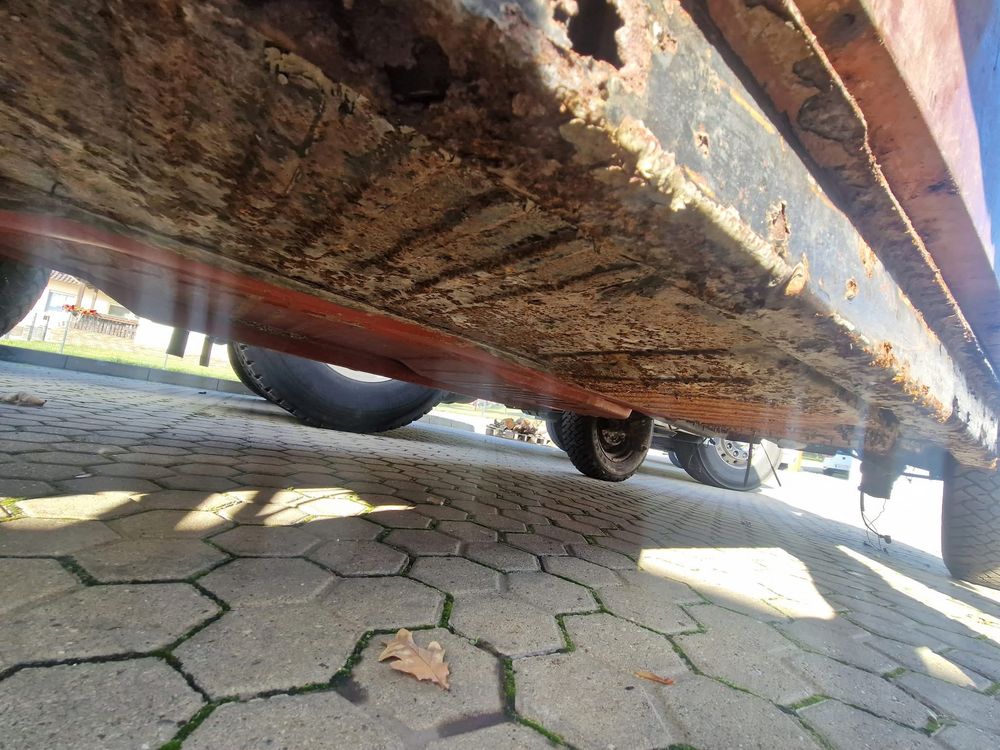
Heater channel from below: the rust is flaking and there are already holes in the metal.
For the bottom of the channel there are repair bottoms, separate versions for the 1302/1303 and complete heater channels for 8/1960–7/1968 and 8/1968–1990.
Frame head
The frame head is the front end of the central tunnel chassis, where the front axle is mounted. Water and road dirt collect here, especially on the underside. On the 1302/1303 with strut front suspension the frame head is built differently from the standard Beetle – check the model when buying panels.
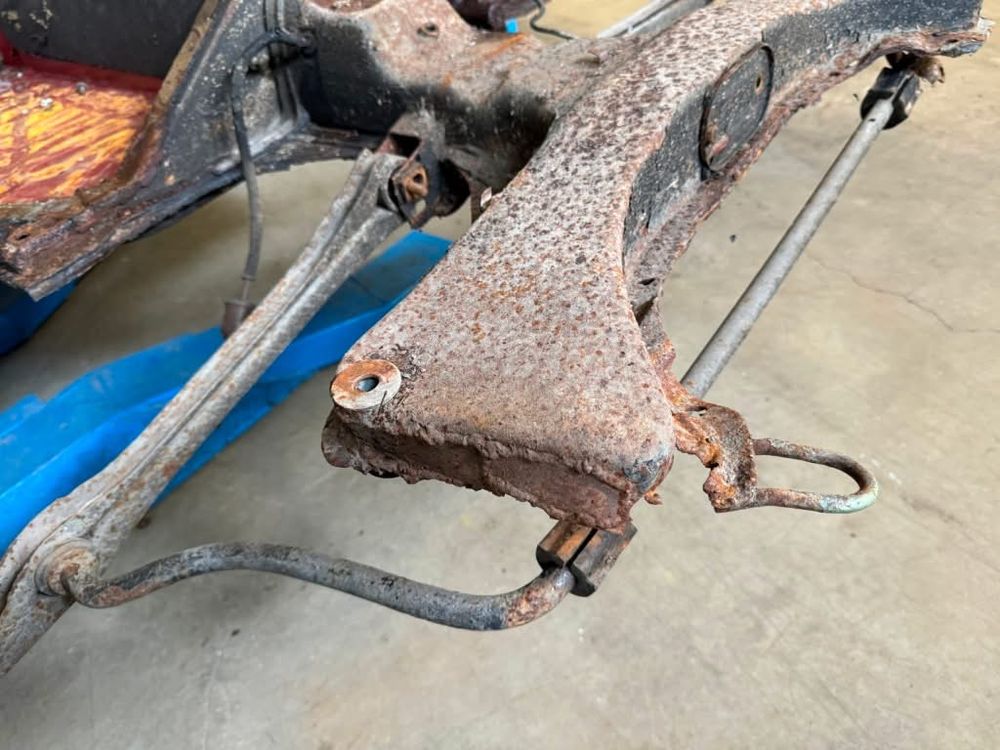
Frame head of a 1302/1303: deep pitting, the underside has burst open – only a new panel helps here.
Standard Beetle: frame head lower plate 8/1952–7/1965, 8/1965–1990 and “Napoleon hat” (reinforcement to the passenger compartment). 1302/1303: frame head lower section or complete frame head. While you are there, check the front axle too – see Front axle check and greasing.
Rear quarter ends
The rear quarter ends sit behind the rear wheels and carry the bumper brackets. Dirt from the wheel arch collects here and stays damp for a long time. A loose bumper bracket is often the first sign.
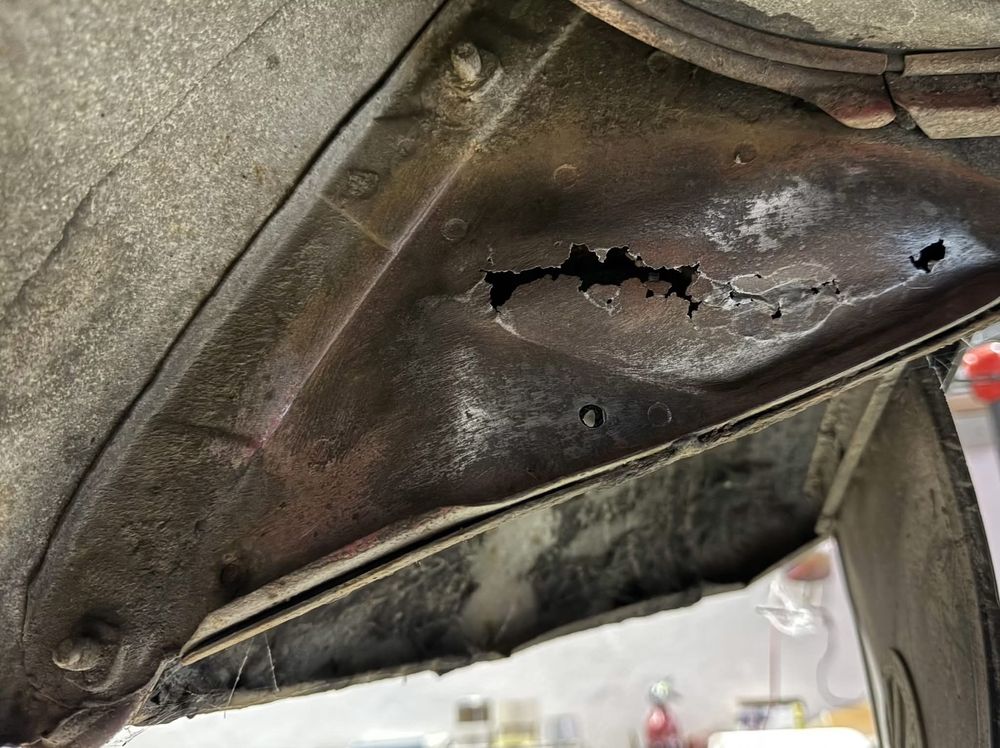
Rear quarter end: under the underseal the metal has already rusted through.
Matching panels: rear quarter end left 8/1967–1990, right and bumper bracket plate left up to 7/1967 and right.
Floor pans and the area under the battery
On the Beetle the battery sits under the rear seat on the right. Leaked acid and condensation eat the floor pan from the inside. Lift the rear seat and check the battery tray. Damp carpets and insulation mats in the footwell are a warning sign for rust in the floor – the water often comes in through leaking seals.
Panels: floor pan ¼ rear right (battery), ½ rear right, ¼ rear left, front left, front right and OE-quality floor pan halves (8/1970–7/1972) left / right.
Spare wheel well
The spare wheel well is the lowest point in the front boot. Water that gets in past the bonnet seal collects here under the mat. Spare wheel well 111 805 583 A, for early Beetles also the DKB version 1955–1960.
Door bottoms and lower pillars
Blocked drain holes in the doors let water stand in the door bottom. Also check the base of the A and B pillars where they meet the heater channel. Door bottom panel left, right.
Rear quarter panels
Bubbles often appear low down in front of and behind the rear wheel arch. Small areas can be fixed with repair sections; for major damage there are rear quarter panels left and right.
Strut towers on the 1302/1303
On the 1302 and 1303 the strut towers in the front boot rust around the strut mount. Rust here is safety-relevant and belongs in a body shop – ask us which panels fit.
Step by step: checking a Beetle for rust
- Prepare: raise the car safely onto axle stands and have a good light ready.
- Heater channels: tap the underside of both channels with a screwdriver and check the jacking points. If the metal gives or sounds dull, it is rotten.
- Frame head: look at it from below between the axle tubes and check it from the front boot.
- Interior: lift the rear seat, check the battery tray. Lift the carpets and look at the front and rear floor pans.
- Front boot: take out the mat, check the spare wheel well and, on the 1302/1303, the strut towers.
- Doors: open the doors, check the bottom edges and the base of the pillars. Do the doors rub when closing?
- Rear: check the rear quarter ends in the wheel arch, the bumper brackets and the rear quarter panels.
- Magnet test: where the paint is suspiciously smooth, try the magnet. If it hardly holds, there is often filler underneath.
Preventing rust
- Get the water out: keep the drain holes in the doors and at the frame tunnel clear; from 8/1966 the Beetle has a drain rubber at the rear of the tunnel.
- Protect the cavities: flood the heater channels, doors, rear quarter ends and frame head with cavity wax – ideally every year before winter.
- Wax-based underseal: remove old, flaking underseal – rust is worst underneath it – and protect the underside again.
- Renew seals: leaking window, door and bonnet seals are the main cause of rust in the floor and spare wheel well.
- Keep the battery clean: wash off acid residue and strap the battery down firmly.
- Park it dry: do not put a wet car into a closed, unventilated garage.
Repairing rust – an overview
Panel repairs on the Beetle always follow the same sequence. Load-bearing parts such as the frame head, heater channels and floor pans are best welded by a professional body shop – it is a question of safety and matters at the roadworthiness test at the latest.
- Find the extent: expose the rust until you reach sound metal. The damage is often bigger than expected.
- Support the body: when replacing the heater channels, support or brace the body so that door gaps and dimensions stay correct.
- Cut out the old metal and fit the repair panel accurately.
- Weld: with MIG in short tacks or sections so that the panel does not distort.
- Protect: seal the seams, prime, paint and protect the cavities.
Our repair panels for the Beetle
- All body and repair panels VW Beetle
- Floor & chassis – floor pans, heater channels, frame head, rear quarter ends
- DKB premium body parts for Beetle 1946–1967 – accurately fitting panels for early Beetles
- OE-quality floor pan halves – when the floor is rotten over a large area
Tips from the workshop
- When buying, look underneath first: nice paint says little on a Beetle – heater channels, frame head and floor decide the value.
- Buy panels to match the year: heater channels, rear quarter ends and frame head changed several times. If in doubt, ask us with your chassis number.
- Do not just weld it up: without cavity protection a new panel soon rusts again.
Common mistakes
- Filling holes or covering them with underseal: the rust keeps working underneath.
- Replacing heater channels without support: the body sags and the doors no longer fit.
- Only repairing the visible spot: the rust usually goes further in than expected.
- Not protecting after welding: new rust starts right at the welds.
Frequently asked questions
Where does the VW Beetle rust most often?
At the heater channels, the floor pans – especially under the battery on the right under the rear seat –, the frame head, the rear quarter ends, the spare wheel well and the door bottoms. On the 1302/1303 also at the strut towers.
How do I recognise rotten heater channels?
Tap the underside with a screwdriver and check the jacking points. If the metal gives, sounds dull or the doors rub, the channel is weakened.
Can I repair rust on my Beetle myself?
Small areas on non-structural parts yes, if you can weld. The frame head, heater channels and floor pans are load-bearing – this work should be done by a body shop.
How do I protect my Beetle from rust?
Keep the drain holes clear, treat the cavities with cavity wax every year, renew old underseal, keep the seals tight and park the car dry.
Matching parts and more guides
- Categories: VW Beetle body & repair panels, Floor & chassis, all body panels, DKB premium 1946–1967
- More guides: Front axle check and greasing, Shift coupler replacement, Chassis torque specs
- All guides at a glance
All information without guarantee. Welding on load-bearing parts is safety-relevant – have it done by a professional body shop. All work is carried out at your own risk.