
Checking and Greasing the Front Axle on the VW Beetle and Bus T1/T2: Grease Points, Ball Joints, Link Pins and Check Values
In short: The front axle of the Beetle and Bus needs grease – and it does not forgive you if it does not get any. Grease king and link pin axles (Beetle up to 7/1965, Bus T1) at every oil change, ball joint axles (Beetle from 8/1965, Bus T2) every 10,000 km (6,000 miles) or once a year. To check, rock the raised wheel: play top/bottom points to the ball joint, link pins or wheel bearing, play left/right to the tie rod or steering. Ball joints are worn at 2 mm (0.08 in) of play.
At a glance
- Fits: VW Beetle and Karmann Ghia (king and link pin and ball joint axle, 1302/1303 briefly), VW Bus T1 (up to 7/1967) and Bus T2 (8/1967–1979)
- Typical symptoms: clunking over bumps, vague steering, car pulls or wanders, tyres worn on the inside or outside
- Time: greasing approx. 30 minutes, checking approx. 1 hour
- Difficulty: easy – replacing joints: medium to hard
What you need
- Jack, axle stands, wheel chocks for the rear wheels
- Grease gun with lithium-based multi-purpose grease
- Tyre lever or strong pry bar, vernier caliper or feeler gauge, torch
- A helper for the rocking test and the steering play
- Rags, brake cleaner and, if needed, new grease fittings
Safety: Never work under a vehicle that is only on the jack – always use axle stands and chock the rear wheels. Worn ball joints, link pins or tie rod ends are a safety risk: if the play is beyond the wear limit, do not drive any more – replace the parts.
Which front axle does your vehicle have?
Before you pick up the grease gun, you need to know which axle is fitted – the grease points, check values and spare parts depend on it:
| Vehicle | Axle type | Grease fittings | What you check |
|---|---|---|---|
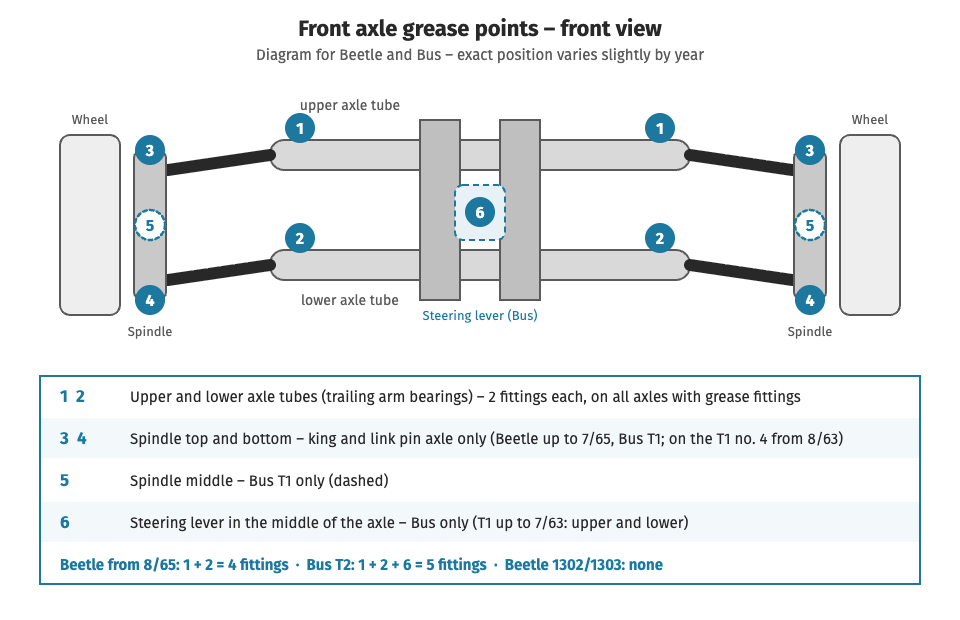
| Beetle, Karmann Ghia up to 7/1965 | King and link pin axle | 8: 4 on the axle tubes, 4 on the spindles | Play in link pins and king pins |
| Beetle, Karmann Ghia from 8/1965 (except 1302/1303) | Ball joint axle | 4 on the axle tubes | Ball joints, tie rod ends, wheel bearings |
| Beetle 1302 and 1303 (from model year 1971) | MacPherson strut with control arm | none | Ball joint on the control arm, control arm bushes, tie rods |
| Bus T1 up to 7/1967 | King and link pin axle | 4 on the axle tubes, 4–6 on the spindles, steering lever | Link pins, king pins, steering lever shaft |
| Bus T2 8/1967–1979 | Ball joint axle | 5: 4 on the axle tubes, 1 on the steering lever | Ball joints, tie rods, steering play |
The right check values
| Check point | Beetle (ball joint axle) | Bus T2 |
|---|---|---|
| Ball joint play | new 0.5 mm (0.020 in), wear limit 2.0 mm (0.079 in) | axial, wear limit 2 mm (0.079 in) top and bottom |
| Tie rod ends | no play | no play |
| Wheel bearing play | 0.03–0.12 mm (0.001–0.005 in) (adjustment see Chassis torque specs) | adjust the clamp nut, Allen screw 15–20 Nm (11–15 ft-lb) |
| Steering play at the steering wheel rim | – | worm and roller max. 15 mm (0.6 in), worm and peg max. 25 mm (1.0 in) |
| Camber | +30′ ± 20′ (eccentric bush on the upper ball joint) | +0°40′ ± 20′, max. 30′ difference left/right |
| Toe (total) | have it measured by a workshop | +15′ ± 15′ (equals 0–3.6 mm / 0–0.14 in) |
Values according to VW factory data and the repair manual. For the king and link pin axle (Beetle up to 7/1965 and Bus T1): the pins must not have any noticeable play – if the play can no longer be removed, the axle is rebuilt.
Step by step: checking the front axle
1. Prepare
- Park the vehicle on level ground and chock the rear wheels.
- Raise the front and put it safely on axle stands so that both front wheels hang free.
- Inspect the boots of the ball joints and tie rod ends with a torch: cracks or leaking grease mean that dirt and water get in.
2. Rocking test at 12 and 6 o’clock
- Hold the wheel at the top and bottom and rock it firmly.
- Noticeable play comes from the ball joint (or the link pins) or from the wheel bearing.
- To tell them apart, a helper presses the brake. If the play disappears, it is the wheel bearing – if it remains, the joint is worn.
3. Rocking test at 3 and 9 o’clock
- Hold the wheel on the left and right and move it back and forth.
- Watch or feel the tie rod ends: if the ball stud moves in its housing, the end is worn.
- If the tie rods move but not the wheel, the play is in the steering box or the steering lever (on the Bus).
4. Measuring the ball joints
- Put a tyre lever under the tyre and push the wheel upwards – this makes the play in the joint visible.
- Measure the play at the joint with a vernier caliper or feeler gauge.
- Beetle: new 0.5 mm, replace from 2.0 mm. Bus T2: replace from 2 mm top or bottom. Always compare both sides.
5. Checking the steering play (Bus T2)
- Vehicle on its wheels, wheels straight ahead.
- Turn the steering wheel slowly back and forth until the wheels just start to move.
- Measure the travel at the steering wheel rim: worm and roller max. 15 mm (0.6 in), worm and peg max. 25 mm (1.0 in). More play: first check tie rods and steering lever, then the steering box.
Beetle 1302 and 1303
The strut front axle has no grease fittings. Use the rocking test to check the ball joint on the control arm, the rubber bushes of the control arm and the tie rods – on the 1303 from 8/1974 with rack and pinion steering also the rack boots.
Step by step: greasing the front axle
- Take the load off: raise the front so that the wheels hang free. Under load the axle hardly takes any grease.
- Clean the fittings: wipe every grease fitting with a rag so that no dirt is pressed into the bearing.
- Pump in grease: put the grease gun on straight and pump until fresh grease comes out at the bearing. The aim is to push out the old grease – not just to top up.
- King and link pin axle: when greasing the spindles, turn the wheels once from lock to lock so that the grease spreads.
- Fitting does not take grease: unscrew the fitting, clean it or fit a new grease fitting (M8 straight, M8 90°, on the Bus T1 also M10 × 1 90°).
- Clean up: wipe off excess grease – otherwise it collects dirt.
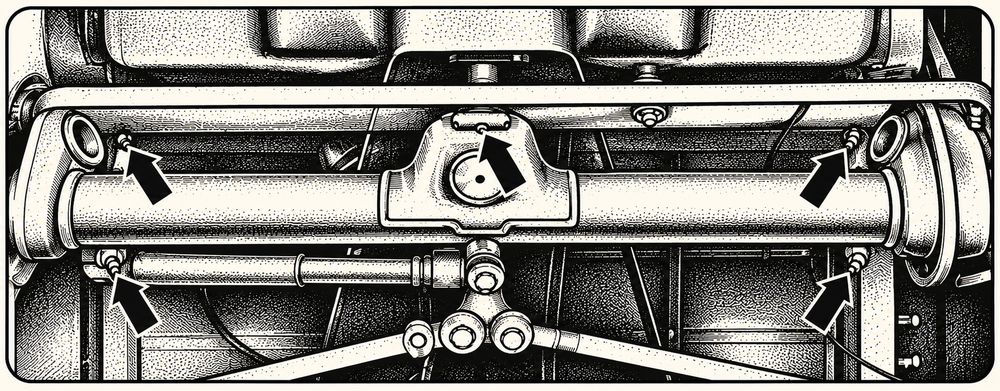
The 5 grease fittings on the VW Bus T2: two each on the upper and lower axle tubes, one in the middle on the steering lever.
| Axle | Greasing |
|---|---|
| King and link pin axle (Beetle up to 7/1965, Bus T1) | at every oil change, i.e. every 5,000 km (3,000 miles) or once a year |
| Ball joint axle (Beetle from 8/1965, Bus T2) | every 10,000 km (6,000 miles) or once a year |
| Beetle 1302/1303 | no grease fittings |
Which parts fit?
| Vehicle | Complete kit | Single parts |
|---|---|---|
| Beetle, Karmann Ghia up to 7/1965 | Link pin and king pin repair kit (both sides) | Grease fittings |
| Beetle, Karmann Ghia from 8/1965 | Front axle rebuild kit (4 ball joints, seals, fitting kit) | Upper ball joint, lower ball joint, tie rod end large taper, small taper, wheel bearing kit |
| Bus T1 4/1955–7/1962 | King and link pin complete kit | Link pin rebuild kit 10/53–7/62 |
| Bus T1 9/1962–7/1963 | King and link pin complete kit | Link pin rebuild kit 1962 (VIN from 999 305)–7/63 |
| Bus T1 8/1963–7/1967 | Link pin complete kit or BBT ball joint conversion kit | Link pin rebuild kit, king pin and link pin repair kit |
| Bus T2 8/1967–1979 | MEYLE HD ball joint set with trailing arm seals | MEYLE HD ball joint single, boot, tie rod left, right, wheel bearing kit |
All in one: our front axle kits
- Front axle rebuild kit Beetle from 8/1965 – all 4 ball joints with seals and fitting kit
- Link pin complete kit Bus T1 8/1963–7/1967 – kits also for 4/1955–7/1962 and 9/1962–7/1963
- BBT conversion kit Bus T1 8/1963–7/1967 – from link pins to ball joints, no welding
- MEYLE HD ball joint set Bus T2 – reinforced version in German OE quality
Tips from the workshop
- Oversize ball joint on the Beetle: some cars left the factory with oversize joints pressed in. The standard joint has one groove on the cover, the oversize joint two opposite grooves – check before ordering.
- Alignment after replacing joints: new ball joints, link pins or tie rods change toe and camber. Have the axle aligned by a workshop afterwards.
- Grease at every oil change: then you never forget it – for the king and link pin axle this is the right interval anyway.
- Bus T1 with worn spindles: instead of reaming link pins, the BBT ball joint conversion kit can be the better solution.
- Torque specs: ball joint, tie rods and clamp nut are in our guide Chassis torque specs.
Common mistakes
- Greasing with the weight on the wheels: the grease does not reach the bearings.
- Only one or two strokes per fitting: old, dirty grease stays in the bearing.
- Mistaking wheel bearing play for ball joint play: always cross-check with the brake pressed.
- Ignoring torn boots: a joint with an open boot will soon be worn.
- Replacing only one side: renew joints and tie rod ends in pairs if possible.
Frequently asked questions
How often do I have to grease the front axle?
King and link pin axle (Beetle up to 7/1965, Bus T1) at every oil change, i.e. every 5,000 km (3,000 miles) or once a year. Ball joint axle (Beetle from 8/1965, Bus T2) every 10,000 km (6,000 miles) or once a year. The Beetle 1302/1303 has no grease fittings.
Which grease do I use?
A lithium-based multi-purpose grease for the grease gun. Pump until fresh grease comes out at the bearing.
How do I recognise worn ball joints?
On the raised wheel: play at 12 and 6 o’clock that remains with the brake pressed. Measured, the joint is worn from 2.0 mm (0.079 in) on the Beetle and from 2 mm top or bottom on the Bus T2.
How many grease fittings does my Beetle have?
Up to 7/1965 (king and link pin axle) 8 fittings: 4 on the axle tubes and 4 on the spindles. From 8/1965 (ball joint axle) 4 fittings on the axle tubes. The 1302 and 1303 have none.
Can I convert my Bus T1 to ball joints?
Yes, for buses 8/1963–7/1967 (and Brazilian buses) there is the BBT conversion kit. It is fitted without welding on the spindle.
Matching parts and more guides
- Categories: VW Beetle front axle, Beetle tie rods & steering, VW Bus T1 front axle & steering, VW Bus T2 front axle & steering
- Grease fittings: M8 straight, M8 90°, M10 × 1 90° (Bus T1)
- More guides: Chassis torque specs, Replacing brake shoes and wheel cylinders, Brake bleeding and adjustment, VW Bus T2 technical data, Rust on the Beetle: typical rust spots
- All guides at a glance
All work is carried out at your own risk. Front axle and steering are safety-relevant – if you are unsure, have the work checked by a professional workshop.